
– On the Land –
RED BERRIES, BLUE RIDGES
A guide to selecting, storing and savoring strawberries
BY ADAM COULTER
***
Strawberries have long been a part of Western North Carolina’s landscape. In his 1791 book Bartram’s Travels, American naturalist and explorer William Bartram traveled by horseback into the heart of what is now Macon County, documenting plants and trees of the region and discovering there a landscape of “fragrant red strawberries, in painted beds of many acres.” As his travels continued into the Cherokee territory, Bartram said there were so many strawberries that the juice of the berries dyed his horse’s feet and ankles.
While wild expanses have since been replaced by tended fields, the annual arrival of the fruit remains a statewide event. North Carolina consistently ranks in the top five strawberry-producing states in the nation.
Strawberry season in our state typically begins in April with our eastern counties growing the berries in the early warming sandy soils of the coastal plains and Piedmont. For our mountain lands and farmers, the season gets underway in May when local markets fill up with an abundance of the celebrated red berry.
Many local farms grow strawberries and other berries to supplement their main cash-pro- ducing crops. Flying Cloud Farm in Fairview grows about 10,000 strawberry plants on one acre of their 20-acre property, according to co-owner Annie Louise Perkinson, rotating the land between main crops and cover crops to aid in soil recovery and organic practices.
Planted yearly in September, Flying Cloud’s Chandler variety strawberries are June bearing, meaning they grow through the winter, bloom in spring and are ready for harvest in mid-May through earlyu June. Frost cover blankets are used to prevent cold damage during the winter months while the plants establish growth, then removed in the spring to ensure pollination.
HOW TO: SELECT + STORE
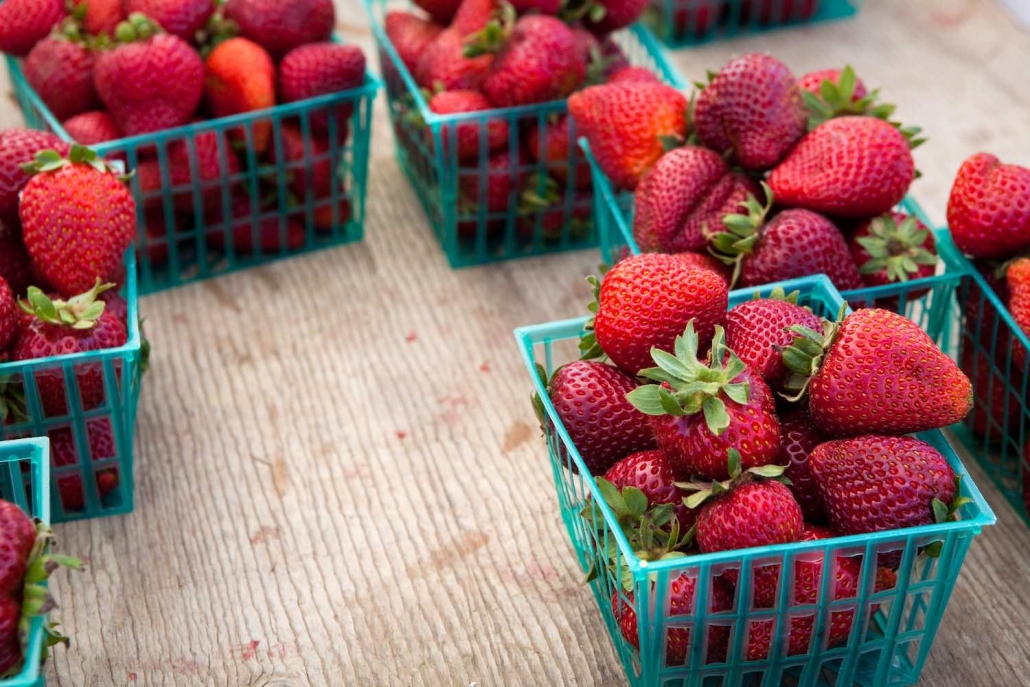
Capture the local strawberry season at its peak by selecting firm, plump, fragrant strawberries. Strawberries do not continue to ripen once they are harvested, so be sure to select berries that are fully mature and solid in color.
For the freshest taste, it’s best to eat strawberries the same day they’re purchased. But if you can’t, keep them in the crisper drawer of your refrigerator, unwashed, with the leafy caps still intact until ready for use.
Store the strawberries at 35°F for best results. If they’re packaged in a plastic clamshell-type container, keep it closed, or store the berries in a partially opened plastic bag to keep them in high humidity. Strawberries will stay fresh up to seven days under optimum conditions.
Fresh strawberries are not only delicious, but are also rich in nutritional benefits. High in antioxidants and compounds such as anthocyanin, resveratrol and ellagic acid, strawberries may help reduce inflammation, reduce the risk of heart disease, hypertension and some cognitive effects of aging.
Strawberries are cholesterol free, have only 50 calories per cup, and are a good source of vitamin C and essential minerals such as manganese and potassium.
FRESH, FROZEN OR DRIED
Generations of North Carolinians have grown up with homegrown strawberries playing a part in their spring and summer traditions.
Whether picked and eaten fresh as a healthy snack, frozen, dried or processed into jam, jelly or preserves, the strawberry season doesn’t have to end with the change of the calendar.
Serving the citizens of Buncombe County since 1915, NC Cooperative Extension’s Family & Consumer Science Agents can provide valuable resources and research-based advice on food preservation, food safety, storage and even starting a food business.
As strawberry season gets underway this spring, take a moment to support a local farmer, either by visiting a U-Pick farm, tailgate market or buying North Carolina strawberries from the grocery store. By doing so, you are participating in a timeless ritual that honors the soil, the season and the hands that harvest.
Strawberry Freezer Jam
Recipe courtesy of NC State Cooperative Extension
Makes about 6 half-pint jars
8 cups halved fresh strawberries
1½ cups sugar
5 tablespoons fruit pectin
6 half-pint freezer jars
Pulse strawberries in a food processor until finely chopped. Stir in sugar and let stand for 15 minutes. Gradually stir in pectin, stirring for 3 minutes. Spoon into jars, leaving ½ inch headspace. Center lid on jars, apply bands and adjust loosely. Once jam is frozen, adjust bands to fingertip-tight.
Store in freezer up to 1 year. Thaw each jar in refrigerator and use within 3 weeks.
*Use the most up-to-date information and resources during any food preservation project and follow the guidelines established by the company whose products you use.
When purchasing strawberries, leave on the leafy caps until you’re ready to eat them.