
– Global Appalachia –
A TASTE OF OKINAWA IN APPALACHIA
From purple sweet potatoes to sake with friends, a look at the habits in one of the original Blue Zones—and how to practice them close to home.
BY AMY BESS COOK
***
In 2000, journalist Dan Buettner led an expedition to study the remarkable longevity of the people of Okinawa, Japan. At the time, Okinawans had lower rates of cancer, heart disease, and dementia than any population in the world. The research soon expanded to reveal other regions where people regularly lived long, healthy lives: the so-called Blue Zones.
Over the past two decades, the list of zones has shifted—and alas, Okinawa has lost its crown as the top contender. Still, what made it so special in the first place? And how can we savor a taste of Okinawa here in Appalachia?
Whether dining at local Japanese restaurants or cooking lighter fare at home, here are a few ways to incorporate Okinawan and Blue Zone habits into everyday life.
EAT WHOLE, PLANT-BASED FOODS
At a crossroads of influences, Okinawan cuisine—also known as Ryukyuan fare—has been shaped by Chinese, Southeast Asian, and even Western cultures. Distinct from mainland Japanese food, it is more rustic, incorporating pork, tropical fruits, seaweed, and fresh vegetables.
The main ingredients used by Okinawa cuisines are mostly healthy and nutritious foods,” says Naomi Sugi, manager of Asheville’s Heiwa Shokudu. “Ginger, green onions, tofu, seaweed, mushrooms and sweet potatoes.”
With a strong focus on vegetarian and vegan options, Heiwa offers dishes like the Spicy Tempeh Roll and Tofu Hot Pot.

A woman in Okinawa. Photo courtesy of the Okinawa Convention and Visitors Bureau.
Consider these staples of the Okinawan pantry:
Okinawan Purple Sweet Potato | Beni-imo
Creamy, sweet, and brilliantly colored beneath its thin white skin, the Okinawan purple sweet potato is rich in the antioxidant anthocyanin, along with B vitamins, potassium, and fiber.
A true Okinawan sweet potato—distinct from the more common Japanese sweet potato—can be hard to find off the island. But you can improvise with a visit to Heiwa, where you’ll find Sweet Potato Tempura. A few blocks away, at Ukiah Japanese Smokehouse, try the sweet potato appetizer, slathered in miso butter, brown sugar, parmesan, and umami salt.
Bitter Melon | Goya
Packed with vitamins, potassium, and fiber, bitter melon is a nutritional powerhouse used in traditional medicine around the world to help regulate blood sugar and reduce inflammation. On Okinawa, it’s often featured in a stir-fry called Goya Chanpurū, typically made with egg, tofu, and pork belly. To try your hand at Goya Chanpurū, start with a visit to a local specialty shop like Asiana Market in South Asheville, where bitter melon is usually in stock.
Seaweed
Hailed as a superfood for its ability to help lower cholesterol and support immunity, mineral-rich seaweed comes in many forms. Kombu, wakame, and mozuku are all beloved in Okinawan cooking. “I love the dedication and technique that is put into some of the
Okinawan ingredients such as seaweed, specifically kombu,” says Chef Michael Lewis of Ukiah Japanese Smokehouse. At the restaurant, kombu is used to create the stock for Kinoko Kamameshi—just one of many seaweed-forward dishes around town.
DRINK IN MODERATION—WITH FRIENDS
Blue Zones share an unexpected trait: many of these long-lived populations drink alcohol regularly, even daily. The key is moderation—and, just as important, community.
On Okinawa, the drink of choice is awamori, a spirit distilled from rice and black koji. While awamori is difficult to find in North Carolina, Asheville offers a lively alternative with sake. Ben’s Tune-Up (soon to be known as Tiger Ben’s) has been cultivating community around sake since 2013.
“Fostering a sense of community comes naturally,” says Phillip Singh, a collaborator in the evolving venture, “when you offer a local product that’s both affordable and steeped in Appalachian culture.”
TAKE IT SLOW
“If you’ve ever been to Japan,” says Chef Michael Lewis of Ukiah, “You can feel how busy everyone always is. The place buzzes with energy all hours of the day. One thing you don’t see and can’t/shouldn’t do is eat on the run.”
Here at home in the mountains in North Carolina, we can afford to slow down—at mealtime and beyond. Whether it’s a few deep breaths at the office or a sunset walk in the park, even small pauses in the day can make a meaningful difference.
87 N Lexington Ave, Asheville, NC 28801
(828) 254-7761
121 Biltmore Ave, Asheville, NC 28801
(828) 470-7480
Ben’s Tune-Up (a.k.a. Tiger Ben’s)
195 Hilliard Ave, Asheville, NC 28801
(828) 407-0436
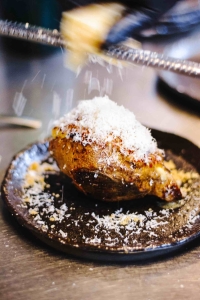
The Okinawan purple sweet potato is rich in antioxidants, B vitamins, potassium and fiber.
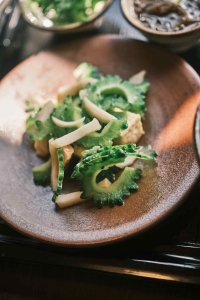
In Okinawa, bitter melon – or goya – is often featured in a stir fry called Goya Chanpuru.