– Perspective –
A Q&A WITH HAL HERZOG
Alligators, ramps and vegan ice cream: How local academic and author Hal Herzog studies the relationship between humans and animals
BY BROOK BOLEN | PHOTOS BY ERIN ADAMS
***
Herzog writes the blog “Animals and Us” for Psychology Today magazine, and his 2010 book Some We Love, Some We Hate, Some We Eat: Why It’s So Hard to Think Straight About Animals offers fascinating food for thought on topics like factory farming, animal rights activism and pet ownership.
We sat down with Herzog to discuss food, animals and our relationships with both.
EA: Your research on anthrozoology is so specialized and yet so relevant to every person on the planet. How did you get involved in that area?
I became interested in how we relate to and think about animals back in the 1970s, when the animal rights movement was starting to take off. My first research was on the clandestine subculture of cock-fighting in Western North Carolina and East Tennessee. I spent a couple of years investigating how perfectly normal people justified their involvement in a patently cruel activity.
At some point, I realized my own hypocrisies. For example, I eat chicken. However, our collective desire for hot wings and Chicken McNuggets causes far more animal suffering than Appalachian rooster fights. After all, gamecocks have much longer and vastly better lives than the short, brutal existence of 9 billion chickens raised in the dank squalor of American factory farms.
Over the years, my students and I have studied topics ranging from the psychology of animal rights activists and women hunters to the decision-making processes of animal research ethics committees.
For a psychologist, it’s been a wild ride. Our convoluted relationships with other species offer a unique window into human moral psychology. As the anthropologist Claude Levi-Strauss, wrote, “Animals are good to think with.”
EA: Is it possible to identify one or two of your findings from your studies that you find especially meaningful or important?
Yes. Perhaps the most important one is that our attitudes towards other species are fundamentally incoherent.
Human moral thinking involves a messy mix of logic, emotion and intuition. For example, in a national survey, 47% of people agreed with the statement “Animals are just like people in all important ways.” Yet, over 95% of them ate meat. As one of my colleagues once told me, “The only thing consistent in our relationships with other species is inconsistency.”
EA: Knowing what you know about the experiences of different animals on earth, if you were to be reincarnated as an animal, what would you want to come back as and why?
An alligator. I was fascinated by gators when I was a kid in Florida. I jumped at the chance to study them down there when I was in grad school. For a couple of years, I investigated how mother gators looked after their babies and how alligators talk to each other.
Mary Jean [Herzog’s wife], who was my girlfriend at the time, and I would catch baby gators from our canoe at night. They are really cute. We did not have cages for them, so we just turned them loose in our apartment in Gainesville where they could run around the floor. I am still surprised she married me.
EA: With the onset of spring here in the mountains, what are your favorite food-related things about the season?
The farmers markets! Mary Jean and I try to hit the North Asheville farmers market on Saturdays and the Weaverville farmers market on Wednesdays. Spring also brings seasonal changes to local restaurant menus. For example, ramps—those wild mountain onions—start showing up on menus from mid-April through May.
EA: Spring also seems to be a time when many people revive their good habits, like eating fresh vegetables or daily exercise. What types of things do you rely on to maintain a sense of wellness?
Wellness, for me, is about being outdoors, usually on water. When we moved to Cullowhee, I realized that we were living in one of the best locations in the world for kayaking. For 20 years, whitewater boating became a central theme in our family life. Our children Adam and Katie caught the bug and became nationally known kayakers.
While I have slowed down in recent years, I still love kayaking on the French Broad, the Tuckasegee and Nantahala, especially with my grandkids. I am excited that the new Taylor’s Wave in Woodfin will soon be open for playboating.
EA: As a kid, what types of foods did you eat when you were growing up? Did you have special family dishes?
I was raised in Miami, Florida, and we had avocado, banana and mango trees in our backyard, and a truck loaded with fresh veggies would drive around our neighborhood a couple of times a week. Because our mother was from South Carolina, we grew up on Southern food—grits, okra, fried chicken, chicken livers. My father was a Pan American airlines pilot. He flew DC-3 prop planes from Miami and sometimes brought us Cuban sandwiches, our favorites, home after his trips.
EA: What are your favorite places in and around Asheville to enjoy a meal?
After living in the area for 50 years, my wife Mary Jean and I experienced the extraordinary transformation of Asheville into one of the most exciting culinary cities in the country. For an evening dinner downtown, we like The Market Place, Ukiah Japanese Smokehouse, Chai Pani and Chestnut.
Over the last four years, we have gone to nearly 50 little places that do not get media attention. Among the standouts are Mr. Kabob, Eggs Rancheros Kitchen, Silverbells Sub Shop (and pinball emporium) and Oak and Iron BBQ on River Road.
For the most authentic Mexican food in town, it’s Taqueria Muñoz on Patton Avenue. Our new favorite is Piccolina—a cozy, insanely good Italian cafe in the River Arts District.
EA: If you were stranded on a desert island and could only eat one thing, what would it be?
I am a foodie, and for me that would be culinary hell. Humans evolved to thrive on varied diets. As omnivores, our brains are programmed to rapidly habituate to flavors. So even tasty foods, eaten for breakfast, lunch and dinner will soon become tiresome.
I asked my friend David Nieman, a nutrition researcher at Appalachian State University, what would be the single most nutritious food for life on the island. He said potatoes. But an all-spud diet will only keep you alive for a year or so as they lack essential vitamins, minerals and fats.
But his wife Cathy, a dietitian at a nursing home, immediately chimed up with a better answer. “Hal, just get a case of Ensure. I’ve kept patients alive on it for years.”
EA: What are you working on and thinking about these days?
An issue I think about a lot is why some people—and not others—seem to understand animals at unusually deep levels. I once interviewed a dozen circus animal trainers. They knew more about animals than academics like me who have PhDs in animal behavior. I wanted to know what made them good at their jobs—the sources of their deep understanding of their tigers, elephants and bears.
Alas, I was unable to discover what their mojo was. I realized that I would need to join the circus for a year to figure them out.
EA: If you could invite anyone from your past or present to attend a dinner party, who would get an invite? And what would you serve them?
My ideal dinner party would have two guests: The University of Pennsylvania’s Paul Rozin founded the field of research on the psychology of food and eating. His studies are so creative. My other dinner guest would be Peter Singer, arguably the most important living philosopher. While his 1975 book Animal Liberation jump-started the modern animal rights movement, he is equally concerned with the well-being of humans.
What would I serve them? Singer is a vegan, so we would dine at Plant—Asheville’s award-winning vegan restaurant. I would leave the menu up to Jason Sellers, the chef. But I would insist on bacon-maple ice cream for dessert. It contains neither bacon nor dairy.
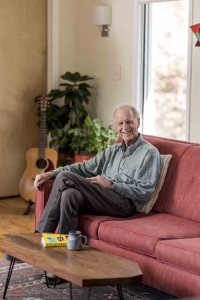
Hal Herzog is an expert in the field of anthrozoology, aka the study of human-animal relationships.
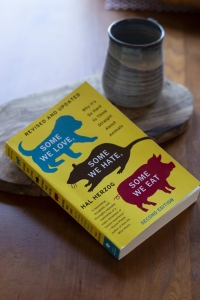
Herzog’s 2010 book Some We Love, Some We Hate, Some We Eat offers fascinating food for thought.